Specimen collection
A cervical, penile/vaginal or urethral swab specimen (or urine) is collected and placed into CarciScan Viral Transport Medium.
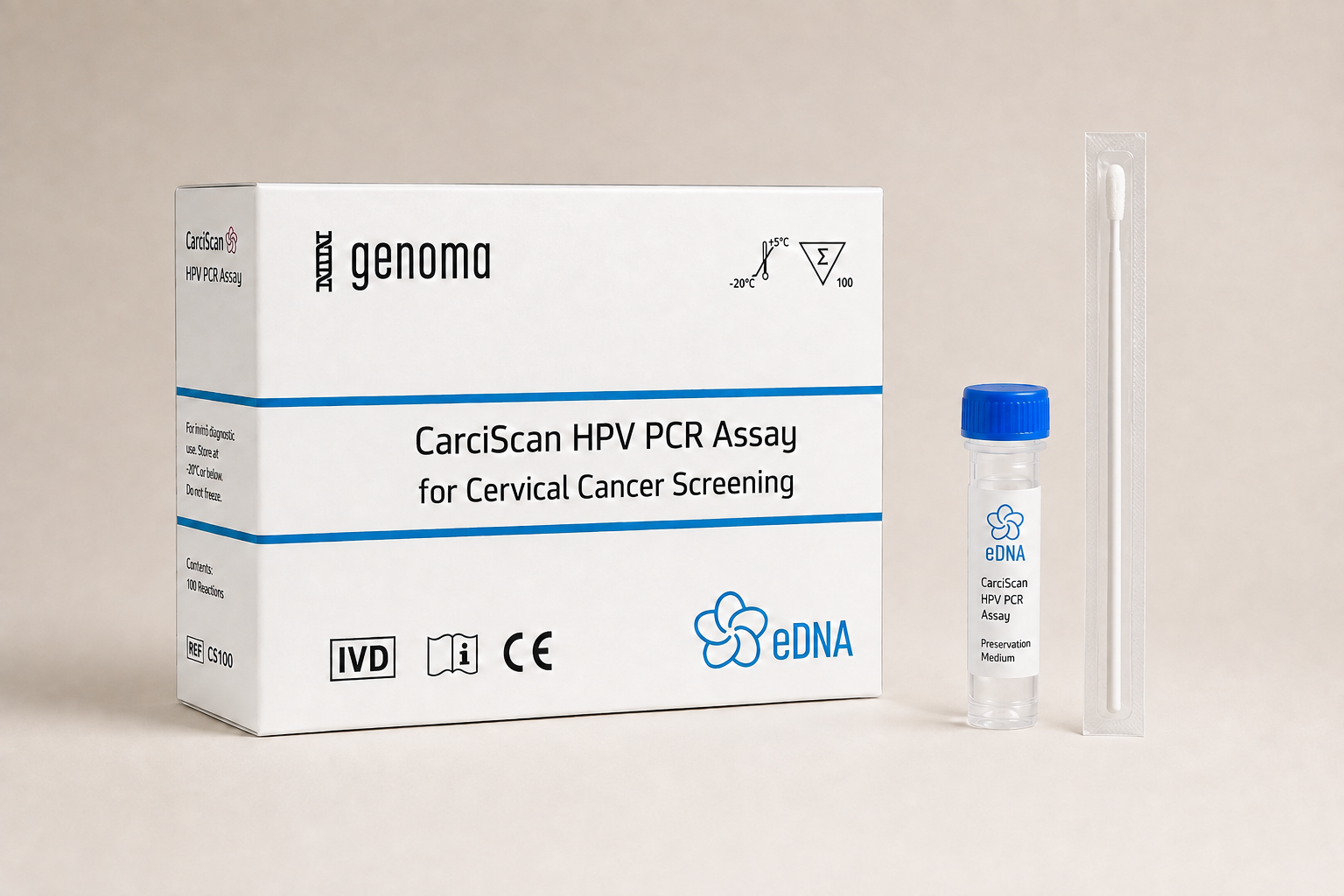
CarciScan is an in vitro screening test based on multiplex real-time PCR. It detects high-risk HPV DNA in cervical, penile/vaginal or urethral swab specimens, or urine, collected using CarciScan Viral Transport Medium.
“This kit is an in vitro diagnostic (IVD) molecular diagnostic test developed for the qualitative detection of high-risk Human Papillomavirus (HPV) genotypes, including HPV 16, 18, 31, 33, 35, 39, 45, 51, 52, 56, 58, 59, 66, and 68, in human clinical specimens. The kit enables specific genotyping of HPV 16, 18, and 45, while screening for the other high-risk HPV genotypes.”IFU, Intended Use, p.1, Rev 04
CarciScan HPV PCR Assay, REF CSHPV10. Up to 96 reactions per kit, 75 × 55 × 65 mm, 26 g.
These three types are individually genotyped and reported. The commercial CarciScan kit (REF CSHPV10) additionally screens 11 further high-risk genotypes — HPV31, HPV33, HPV35, HPV39, HPV51, HPV52, HPV56, HPV58, HPV59, HPV66 and HPV68 — together as a single pooled result, for all 14 high-risk HPV types covered by the IFU. (Source: IFU, Intended Use / Table 1, Rev 04)
Each of the three genotyped types is reported individually, not as a single pooled result. Together, HPV16, HPV18 and HPV45 account for approximately 80% of HPV-positive cases and are considered the genotypes most likely to progress to cervical cancer. (Source: CarciScan scientific advisor, technical Q&A)
The exact, word-for-word collection procedure from the IFU has not yet been extracted into the approved content for this page. The three stages below restate only facts already documented elsewhere on this page; they are not IFU-verbatim user instructions.
A cervical, penile/vaginal or urethral swab specimen (or urine) is collected and placed into CarciScan Viral Transport Medium.
The preserved specimen is analyzed by multiplex real-time PCR on compatible five-channel qPCR equipment, with an RNase P internal control (Internal Positive Control) run alongside every sample.

The HPV-DNA result is reviewed together with cytology history, other risk factors and professional guidelines by the treating physician.

A collected specimen becomes a laboratory result, then a clinical decision, the same five stages every time.
A cervical, penile/vaginal or urethral swab specimen (or urine) is collected and placed into CarciScan Viral Transport Medium.
The CarciScan result is reviewed together with cytology history, other risk factors and professional guidelines by the treating physician. CarciScan does not replace this clinical assessment.
CarciScan uses multiplex PCR with dual-labelled hydrolysis probes (TaqMan principle) to detect all 14 high-risk HPV genotypes in a single run, individually genotyping HPV16, HPV18 and HPV45 and screening the remaining 11 types (HPV31, 33, 35, 39, 51, 52, 56, 58, 59, 66, 68) as a pooled result. An internal control (RNase P, human RNase P gene) is run with every sample as the Internal Positive Control, to confirm DNA extraction and PCR performance. The assay is compatible with five-channel real-time PCR equipment, including Roche LightCycler 480 Instrument II, Corbett Rotor-Gene, Applied Biosystems 7500 Fast, Bio-Rad CFX96, Bio-Rad CFX384 Touch, BioMolecular Systems Bio 4-Channel+HRM, Drawell Gentier 96E and Applied Biosystems QuantStudio 5/7/12K with compatible filter sets. CarciScan uses five detection channels: FAM, HEX, ROX, CY5 and CY5.5.
Source: IFU Table 1 (Materials Provided) & Table 5 (Control design), Rev 04. Internal control confirmed as RNase P (Human RNase P Gene, CY5 channel).
We link every claim to its source and state plainly what each study does and doesn’t prove.
What this shows
CarciScan’s limit of detection is established using International HPV Reference Center plasmids from the Karolinska Institute, achieving 95% or greater positivity across 20 replicates. These results were presented at the European Society of Gynaecological Oncology (ESGO).
Important limitation
This is a laboratory limit-of-detection study using reference plasmid material, not a clinical-accuracy or patient-specimen result. It was presented at a scientific conference, not published as a peer-reviewed journal article.
What this shows
CarciScan is one of 13 HPV assays evaluated in a ten-country collaborative study led by Prof. Joakim Dillner at the Karolinska Institute, covering 100 CIN2+ cases and 200 controls.
Important limitation
The published figures (90.08% pooled sensitivity, 92.00% pooled specificity) are averaged across all 13 assays, not CarciScan-specific. The study is a preprint and has not yet completed peer review.
What this shows
CarciScan is the assay used in the published, peer-reviewed CarciSCAN study protocol in Ghana (n=1,000, Cancer Control, 2025).
Important limitation
This is a protocol publication. Results are not yet available as of the data-room snapshot; full study results are expected from 2029.
What this shows
An early analytical study on 13 specimens showed 95% sensitivity per HPV type and 100% specificity.
Important limitation
Small, non-population analytical sample, not a powered clinical CIN2+/CIN3+ study. Not a general clinical accuracy claim.
What this shows
Letter dated 6 Jul 2026 supporting a Philippines pilot / proof-of-concept deployment, from a co-author on the Karolinska/WHO evaluation.
Important limitation
This is individual expert support for a pilot deployment, not a clinical validation study, regulatory approval, or institutional endorsement by Hacettepe University or any regulatory body.
What this shows
CarciScan’s scientific foundation is connected to Prof. Dr. Murat Gültekin, architect of Türkiye’s national HPV DNA screening program, with published real-world data covering more than 5 million women.
Important limitation
This reflects Prof. Gültekin’s national program leadership, not a CarciScan-specific screening volume: we do not present “5 million screened with CarciScan” as a product claim.
No evidence items in this category yet.
| Item | Framework | Validity | Status |
|---|---|---|---|
| CE marking | Legacy IVDD 98/79/EC (2022), General/Other IVD, not Annex II listed | Declaration of conformity signed 25 Apr 2022 | Valid under legacy IVDD only |
| ISO 13485:2016 | Quality management certificate No. 2023/MDQMS/11045 (IQR) | Validity date on certificate: 09 May 2024 | Renewal status to confirm |
| Turkish ÜTS registration | IVD-Other, registered under IVDD rules | Status “Registered” (Kayıtlı), ÜTS start 20 Feb 2025 | States a future intent to pursue IVDR Class C |
The certificate on file shows a validity date in the past; current renewal status must be confirmed before publication. The ÜTS registration states its own future intent to move to IVDR Class C.
The full commercial CarciScan configuration that Malaya United distributes is three components used together: a sample collection kit, the DNA Elixir™ Isolation Kit (DNA extraction), and the CarciScan HPV PCR Assay (PCR kit). (Source: CarciScan scientific advisor, technical Q&A)
CarciScan HPV PCR Assay (REF CSHPV10, 1 kit = up to 96 reactions):
Shown alongside, as separate REFs used together: a transport tube with CarciScan Viral Transport Medium (REF VTM1001, 1.2 mL) and a collection swab (single-use, not sterile) — together the sample collection kit.
The DNA Elixir™ Isolation Kit (DNA extraction reagents) is the third component of the commercial configuration; its own REF number is not yet documented in the data room.
Running CarciScan also requires standard lab consumables purchased separately and not included in the kit: pipette tips, mini-centrifuge tubes and ethanol. (Source: CarciScan scientific advisor, technical Q&A)
Fields not yet documented in the data room stay visible and are labeled pending IFU.
| Method | Multiplex real-time PCR, dual-labelled hydrolysis probes |
|---|---|
| Target genotypes | All 14 high-risk types: HPV16, 18, 31, 33, 35, 39, 45, 51, 52, 56, 58, 59, 66, 68 (16, 18, 45 individually genotyped; remaining 11 as a pooled result) |
| Intended use | See verbatim statement in the Assay section above |
| Internal control | RNase P (human RNase P gene) — Internal Positive Control, CY5 channel |
| Detection channels | CY5.5 = HPV16 · HEX = HPV18 · ROX = HPV45 · FAM = HPV31/33/35/39/51/52/56/58/59/66/68 (pooled) · CY5 = RNase P (Internal Positive Control) |
| Instrument compatibility | Five-channel real-time PCR equipment, including Roche LightCycler 480 Instrument II, Corbett Rotor-Gene, Applied Biosystems 7500 Fast, Bio-Rad CFX96, Bio-Rad CFX384 Touch, BioMolecular Systems Bio 4-Channel+HRM, Drawell Gentier 96E, Applied Biosystems QuantStudio 5/7/12K with compatible filter sets (FAM, HEX, ROX, CY5 and CY5.5). |
| Time to result | Less than 4 hours |
| Maximum samples per run | Up to 96 patient samples per PCR run (full-plate batch); no fixed 20-sample cap. Recommended batch size for routine high-volume screening is also 96. (Source: CarciScan scientific advisor, technical Q&A) |
| Specimen type | Cervical swab, penile/vaginal swab, urethral swab, or urine |
|---|---|
| Specimen volume | 60 ng gDNA per reaction |
| Stability | 2 to 30°C, up to 72 hours; −20°C if extraction is delayed |
| Transport | 2 to 30°C (or −20°C if delayed), upright, cap fully closed |
| Components | See “What’s in the box” above |
|---|---|
| Full commercial configuration | Sample collection kit + DNA Elixir™ Isolation Kit (DNA extraction) + CarciScan HPV PCR Assay (REF CSHPV10). (Source: CarciScan scientific advisor, technical Q&A) |
| Single-use | Collection swab: single-use item |
| Sterility | Differs by component: swab not sterile, PCR reagent tubes sterile and DNase/RNase-free, VTM not sterile |
| Swab material | pending IFU (specific swab material not specified in the IFU) |
| Swab dimensions | pending IFU |
| Kit box dimensions | 75 × 55 × 65 mm, 26 g |
|---|---|
| Unit of sale | 1 box = up to 96 reactions |
| Cases per carton | pending IFU |
| Temperature range | Reagents: −10°C to −30°C (not recommended at +4°C, except reagents in daily use). Avoid more than 3 freeze-thaw cycles; keep cold during use; store the reaction mixture in the dark. |
|---|---|
| Shelf life, CSHPV10 kit | pending IFU (label expiry date only, no fixed month figure documented) |
| Shelf life, VTM | pending IFU (no shelf-life figure for the transport medium found in the IFU) |
| REF | CSHPV10 |
|---|---|
| LOT format | pending IFU |
| Expiry-date format | pending IFU |
| UDI | pending IFU |
| Insert languages | pending IFU |
| ISO 15223-1 symbols used | Manufacturer, temperature limit, REF, LOT, expiry date (hourglass), CE mark, IVD, “consult instructions for use”, Σ (sufficient for n tests), “keep away from light” |
| CE marking | Legacy IVDD 98/79/EC (2022) |
|---|---|
| Registrations | See Regulatory status above |
| Current IFU revision | Rev 04 (product code CSHPV10) — per the IFU’s own revision history, rev 04 is an editorial/layout-only update; no change to intended use, kit contents, protocol, thermal profile, interpretation criteria or performance data versus earlier revisions. (Source: IFU Revision history, p.9) |
The current IFU (CSHPV10, Rev 04) does not contain a separate “Limitations” section. Reproduced below is the complete Warnings and Precautions section, p.1.
“Read these instructions carefully before starting the procedure.”
“For in vitro diagnostic use only.”
“It should be used by laboratory personnel trained in vitro diagnostic procedures.”
“Follow standard precautions. All patient samples and Positive Controls should be considered potentially infectious samples and processed accordingly.”
“This test should be performed in accordance with Good Laboratory Practices.”
“Do not use the kit after the expiration date.”
“Do not eat, drink, smoke, apply cosmetics or touch contact lenses in areas where reagents and human samples are used.”
“Treat all samples as if they are infectious using safe laboratory procedures.”
The manufacturer’s scientific advisor on what changes as CarciScan moves from a first lab to several hundred or several thousand samples per day.
The right workflow, batch size, staffing and equipment for a first laboratory depend on volume, existing infrastructure, budget and timeline. The manufacturer can provide consultancy on setting up the lab, or deliver the on-site infrastructure directly, where needed.
The single most important addition when scaling up is tracking software integrated into logistics: a central system to know who has been sampled, analysed and recontacted if positive, and when to schedule the next test if negative — alongside where each sample physically is, how many kits each service center holds, and how kit consumption relates to coverage. The manufacturer can advise on this, or develop tracking software for a nationwide Philippine screening program.
Going nationwide requires outcome metrics as feedback — evidence that the program is actually finding disease and saving lives, and that it is cost-effective enough to sustain at scale.
Source: CarciScan scientific advisor, technical Q&A.
Answers drawn directly from the evidence and certification detail above, with the same caveats intact.
Clinical documentation, investor materials, or a distribution enquiry, routed directly.
Reach the Malaya United team directly, or use the options above to request clinical, investor, or distribution materials.
Tell us a little about your organization and we’ll route this to the right person on our team.